
Documented history
Santa Bárbara Church
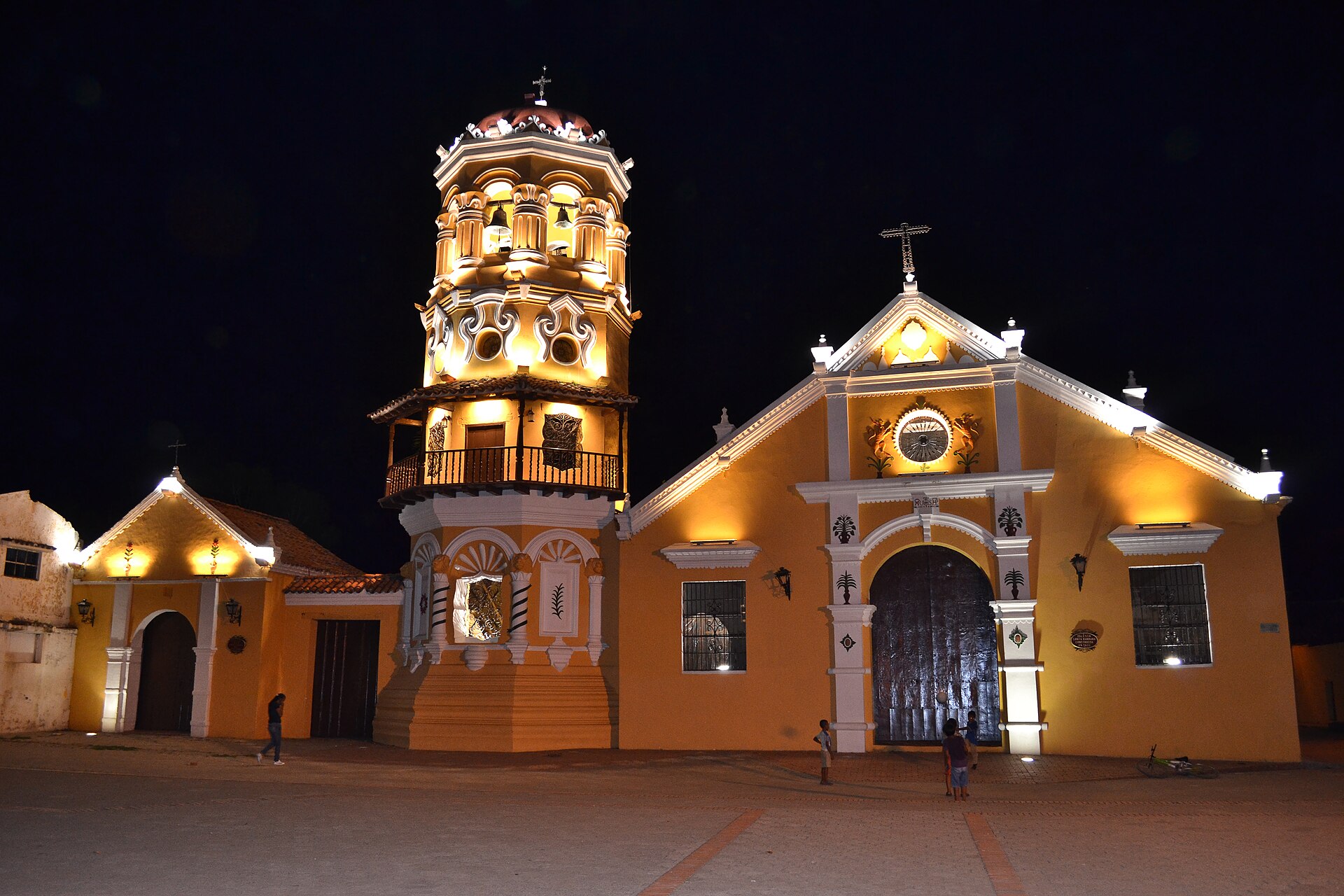
A unique tower on La Albarrada
Santa Bárbara is one of the most recognisable buildings in Mompox. Its history connects the colonial river port, the town's unusual urban form, Caribbean religious architecture and centuries of popular devotion.
Origins in the colonial river town
Santa Bárbara belongs to the urban system that grew along the Magdalena River rather than around a single central square. UNESCO highlights the sequence of riverfront plazas and churches as one of the distinctive features of Mompox.
Historical chronologies commonly associate Santa Bárbara with the early seventeenth century and often cite 1613. That date should be understood as a milestone in the temple's history rather than proof that every visible part of the present building survives unchanged from that year.
Its location beside La Albarrada is important. The riverfront was both a commercial edge and a defensive infrastructure against floods, so the church occupied a place where religion, movement and river life met.
The tower that became a symbol of Mompox
Santa Bárbara is immediately recognisable for its unusual tower. Its octagonal form, balcony and decorative richness distinguish it from the more restrained towers of other churches in the historic centre.
The church already held a strong place in the visual identity of the town by the nineteenth century. British artist Edward Walhouse Mark painted Santa Bárbara in 1845; that watercolour is preserved in the Banco de la República collection.
The building also belongs to a broader local construction tradition using masonry, timber and roof systems adapted to the hot, humid environment of the Caribbean interior.
Devotion, city and World Heritage
Santa Bárbara remains part of the living religious landscape of Mompox. Holy Week processions and other ceremonies connect the churches through the streets, turning the historic centre into an active ritual space rather than a group of isolated monuments.
When the Historic Centre of Santa Cruz de Mompox entered UNESCO's World Heritage List in 1995, the church became part of a protected urban ensemble whose value lies in the relationship between buildings, streets, squares and river.
Visiting Santa Bárbara therefore reveals several histories at once: colonial trade, local craftsmanship, religious continuity, the riverfront city and the modern recognition of Mompox as heritage.
Sources
The history is based on heritage, institutional and historical sources. Dates from secondary chronologies are treated as historical references rather than unquestionable facts when documentation differs.